Dangerous Driving under the Criminal Code of Canada
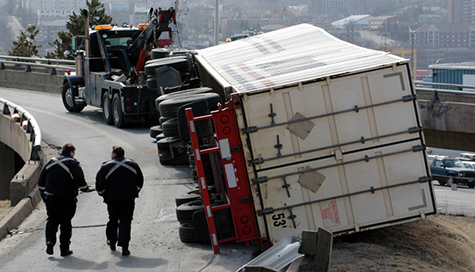
In Regina v. Raj, 2018 ONCA 623 (CanLII) the Ontario Court of Appeal dealt with the conviction appeal for an accused person involving a commercial dump-truck operator. It was a case Dangerous Driving involving alcohol and the use of a Commercial Vehicle. The facts underpinning the appeal involved a proven allegation that the accused had driven the raised box of his dump truck into an over-pass. The accused was/is a professional truck driver. On July 31, 2014, he was driving a commercial dump truck on the Queen Elizabeth Highway (“QEW”). There was a trailer attached to the truck whose box could be raised and lowered using a system of buttons and levers in the truck called the Power Take-off (“PTO”) system. That day, the appellant had left the PTO lever in the ‘On’ position. Under certain circumstances, leaving the PTO engaged permitted the trailer to rise.
The accident scene was chaotic and dangerous, and the police placed the accused in a police car for 2.5 hours for his own safety. The following arguments were raised by the accused’s criminal appeal lawyers: First, it was posited that the trial judge erred by concluding that the appellant’s confinement in the police cruiser for 2.5 hours was not an arbitrary detention contrary to s. 9 of the CanadianCharter of Rights and Freedoms. Second, if that argument was successful, then it was argued that result would be that the police breached both his s. 9 and s. 10 Charter rights. This, it was argued, would call for a reappraisal of the trial judge’s s. 24(2) analysis and lead to a different result – the exclusion of the evidence relating to the smell of alcohol on the appellant’s breath. The Court disagreed. It said that the principal, and continuing, purpose of the appellant’s detention was his own safety. His truck had caused a terrible accident with extensive damage to vehicles and a bridge and injuries to several people. The police noticed the appellant walking around a dangerous accident scene and sitting on a guardrail very close to a damaged and collapsing girder. Importantly, his truck was crushed.
The Ontario Court of Appeal also upheld the decision of the trial judge admitting evidence of a smell of alcohol on the accused’s breath even though the police did not provide access to counsel during the detention, breaching s.10(b) of the Charter. The police conduct was only a mistake and not deliberate misconduct, and the police would have smelled the alcohol even if they had acted properly.
What is more, the Court of Appeal upheld the trial judge’s finding that the accused’s conduct was a marked departure from a reasonable person’s driving. This was mostly due, in large part on the accused’s alcohol consumption, and his failure over forty (40) seconds to notice that the box of his dump truck had raised. The court said that prior to colliding with the bridge superstructure the appellant drove a one (1) kilometer distance for forty (40) seconds without detecting the rising dump box despite its effect on the truck’s handling and despite it being clearly visible from all of the truck’s mirrors.Given all the factors, the Court of Appeal dismissed the possibility of the that period of time constituting an “momentary inadvertence.”
Dangerous Driving Under the Criminal Code of Canada
By way of a simple and general summary of legal information, a restatement of the elements of the dangerous driving offence was provided in Regina v. Beatty, 2008 SCC 5, and Roy, 2012 SCC 26, with a significantly greater emphasis placed on the mental element of the offence and criminal blameworthiness. In Beatty, above, while confirming that the offence does not require subjective mens rea, Charron J., on behalf of the majority, provided for the application of the “modified objective test”, per Regina v. Hundal, 1993 CanLII 120 (S.C.C.), so as to ensure that punishment is imposed only upon those with “a blameworthy state of mind”. To that end, Charron J. held that the assessment of whether the accused’s conduct is a “marked departure” from the norm, is not an aspect of the actus reus, but of the mens rea. Accordingly, an evidentiary burden does not shift to the accused from the Crown’s presentation of a case of objectively dangerous driving – the actus reus. A further determination must be made whether the Crown has proven that the conduct involved a marked departure from the standard of care of a reasonable person in the circumstances that is deserving of punishment – the mens rea. Moreover, it remains open to the defence to raise a reasonable doubt that a reasonable person in the position of the accused would not have been aware of the risk posed by the manner of driving or, alternatively, would not have been able to avoid creating the danger.
In Reginav. Laverdure, 2018 ONCA 614(RD), the Ontario Court of Appeal(“OCA”) allowed the accused’s conviction appeal for dangerous driving causing death and ordered a new trial. The main reason for over-turning the conviction was due to the trial judges failure to analyze the fault component of the legal test.
In that case accused struck and killed a pedestrian who had crossed the road after attending a hockey game at a local arena in Pembroke, Ontario. At appeal, the accused argued that the trial judge made unreasonable findings of fact and that he erred in his analysis of the elements of the offence. The test for dangerous driving under the Criminal Code of Canada (the “Code”) is stated in Section 249 of the Code.; and the legal test has been considered in Reginav. Roy, 2012 SCC 26 (CanLII), [2012] 2 S.C.R. 60, at para. 30; R. v. Reynolds, [2013] ONCA 433, at para. 18.
The court upheld the trial judge’s findings of fact with respect to the accused’s driving speed. Evidence from the accident reconstructionist, several witness, as well as forensic evidence supported the conclusion that he was driving “at a high rate of speed on a city street” (at para. 17). The court further upheld the finding that the circumstances as they existed on the road at the time (large groups of pedestrians crossing the road and walking along it) called for drivers to slow down and proceed cautiously.
It was open to the trial judge to find that the actus reus was established; and that he did not reason backwards from the accident (at paras. 20-22). However, while the Trial Judge correctly identified the proper test for the mens reaof the offence, the trial judge failed to identify “how and in what way” the accused’s driving went beyond negligence or carelessness to a marked departure from the standard of care that a reasonable person would show in the same position. This was not a case where the manner of driving was so egregious as to satisfy the fault element without any additional analysis of the evidence. At paragraph 25, the Court of Appeal stated:
Rather, the trial judge appears to have concluded that the act of driving dangerously necessarily constituted what he referred to as a “marked departure from what a reasonable person would expect in the circumstances”. He did not identify the “how and in what way” the appellant’s driving went beyond negligence or carelessness and reached the level of a marked departure from the standard of care that a reasonable person would show in the same position.
If you have been charged with a Criminal Code Offence under Section 249 (i.e. Dangerous Operation of the Motor Vehicle), call Mr. J.S. Patel, Criminal Lawyer, for a free consultation.
Call 403-585-1980.
Criminal Lawyer in Calgary and Toronto, DUI, Over 80, Domestic Assault, Sexual Assault, Murder, Legal Aid,