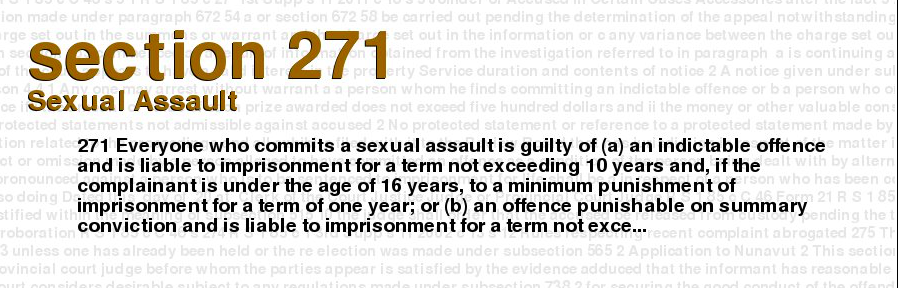
Defence in mistaken belief in consent for sexual assault
In Reginav. Donnelly, 2018 ONCA 575 (CanLII), the Ontario Court of Appeal set aside the accused’s conviction for sexual assault and ordered a new trial. In this case, the complainant was a woman who had been forced into the sex trade. This complainant had testified that she went along with oral and protected vaginal sex, but that during intercourse, the accused performed certain acts, and removed his condom and continued vaginal intercourse without her consent. According to the complainant, during the sexual intercourse the appellant pulled a strap-on out of his drawer and asked if they could use it. The complainant said that she told the appellant no but he proceeded to penetrate her with it. Further she testified that the appellant removed his condom and continued vaginal intercourse, despite the fact that she had told him to keep the condom on.
The accused/appellant flatly denied these allegations. In his testimony, the appellant admitted to the oral and protected vaginal sex, but denied that they had sex without a condom or that he used a strap-on. He also denied ejaculating into the complainant’s vagina but testified that he ejaculated onto her face with her permission. Typically, such evidence would warrant the application of the use of the legal test in Regina v. W(d), [1991] 1 SCR 742, 1991 CanLII 93 (SCC) where ideally, the appropriate instructions on the issue of credibility should be given, not only during the main charge, but on any recharge. A trial judge might well instruct the jury on the question of credibility along these lines:
First, if you believe the evidence of the accused, obviously you must acquit.
Second, if you do not believe the testimony of the accused but you are left in reasonable doubt by it, you must acquit.
Third, even if you are not left in doubt by the evidence of the accused, you must ask yourself whether, on the basis of the evidence which you do accept, you are convinced beyond a reasonable doubt by that evidence of the guilt of the accused.
On appeal, the accused argued that the trial judge erred by placing the defence of honest but mistaken belief to the jury, since it was entirely inconsistent with his testimony denying that the acts in question took place. The court of appeal agreed with that argument because there was “no air of reality” to that defence. An “air of reality” was defined by the Supreme Court of Canada, in the following way in Reginav. Cinous, [2002] 2 SCR 3, 2002 SCC 29(CanLII):
“A defence should be put to a jury if, and only if, there is an evidential foundation for it. A trial judge must thus put to the jury all defences that arise on the facts, whether or not they have been specifically raised by an accused, but he has a positive duty to keep from the jury defences lacking an evidential foundation — or air of reality. This is so even if the defence is the only defence open to the accused. The air of reality test imposes a burden on the accused that is merely evidential, rather than persuasive. In applying the air of reality test, a trial judge considers the totality of the evidence, and assumes the evidence relied upon by the accused to be true. The threshold determination by the trial judge is not aimed at deciding the substantive merits of the defence. That question is reserved for the jury. The trial judge does not make determinations about the credibility of witnesses, weigh the evidence, make findings of fact, or draw determinate factual inferences. Nor is the air of reality test intended to assess whether the defence is likely to succeed at the end of the day. The question for the trial judge is whether the evidence discloses a real issue to be decided by the jury, and not how the jury should ultimately decide the issue.”
Furthermore, the manner in which it was put to the jury obscured the accused’s actual defence and position on what happened. The trial judge misstated the accused’s position by telling the jury that the accused honestly believed that the complainant had consented to the acts in question when he clearly testified that the acts did not take place. The charge would only serve to confuse the jury and a new trial was needed.
Being charged with a serious, violent crime like sexual assault, may call for the assistance of an Criminal Defence lawyer in Alberta or other provinces in Canada. A lawyer will review all the evidence about the alleged sexual assault; and advise his or her client on how best to fight any charges. If the accused was not taken into custody according to the letter of the law, a lawyer might be able to have the charges dropped. An accused client has the right to mount an aggressive defense with the knowledge that it is incumbent upon the Crown to prove guilt beyond a reasonable doubt.
If you have been charged with a sexual assault offence under the Criminal Code of Canada, contact Mr. J.S. Patel, Calgary Criminal Lawyer for an initial free consultation at 403-585-1960.
Aiding and abetting, murder charges and its application in a jury trial.
The legal concept of “aiding and betting” in the context of Criminal Law has presented some difficulties in its application in a number of cases throughout Canada. This criminal law concept applies to varying degrees depending on the nature of the charge under the Criminal Code of Canada (the “Code”). Only occasional mention is made of the alternative basis for finding someone to be a party, the so-called common purpose provision in s.21(2). Subsection 21(1) of the Code provides as follows:
Every one is a party to an offence who(a) actually commits it,(b) does or omits to do anything for the purpose of aiding an any person to commit it, or(c) abets any person in committing it.
In very general terms, while it is common to speak of the concept of aiding and abetting as a singular concept, these two conceptstogether, the two concepts are distinct, and liability can flow from either one. Broadly speaking, to aid under s.21(1)(b) of the Criminal Codemeans to assist or help the actor. To abet within the meaning of s.21(1)(c) includes encouraging, instigating, promoting, or procuring the crime to be committed: Regina v. Briscoe, 2010 SCC 13, at para. 14. :
[14] The actus reus of aiding or abetting is doing (or, in some circumstances, omitting to do) something that assists or encourages the perpetrator to commit the offence. While it is common to speak of aiding and abetting together, the two concepts are distinct, and liability can flow from either one. Broadly speaking, “[t]o aid under s. 21(1)(b) means to assist or help the actor. . . . To abet within the meaning of s. 21(1)(c) includes encouraging, instigating, promoting or procuring the crime to be committed”: Regina v. Greyeyes, [1997] 2 S.C.R. 825, at para. 26. The actus reus is not at issue in this appeal. As noted earlier, the Crown argued at trial that Mr. Briscoe was both an aider and an abettor. The trial judge’s finding that Mr. Briscoe performed the four acts of assistance described above is not disputed.
Under the most applicable concepts of criminal law (at the time of writing), it is irrelevant whether an accused personally committed a crime or aided/abetted the offence, which is why the Crown need not specify in an indictment the exact role the accused played in the offence: Reginav. Pickton, 2010 SCC 32. Thus, in Regina v. McKay, 2012 ABCA 310, even though aiding and abetting are distinct concepts, there was no error in the trial judge’s characterization that the accused did “aid and abet” the commission of the offence. This was simply the judge’s way of describing the accused as a party to the offence. The following are two (2) recent examples of how these concepts come to fruition in Criminal law.
Recently, the Ontario Court of Appeal in Regina v. Mendez, 2018 ONCA 354, the Court set aside jury convictions for first degree murder against the two (2) accused and ordered a new trial. The deceased was shot by one (1) person, and the Crown Prosecution’s theory was that the two (2) accused acted as parties. However, it was unclear who had actually shot the deceased. The trial judge’s instructions to the jury on planning and deliberation listed the evidence supporting the Crown’s theory, but left out the evidence supporting the defence position that there was insufficient evidence that the non-shooter had aided or abetted the shooter. The instructions also failed to relate the evidence to the elements of aiding and abetting but merely invited the jury to consider whether the two accused “acted jointly.”The Crown’s case was weak on the aiding or abetting of the non-shooter, but the jury was not equipped by the trial judge’s instructions to consider the weaknesses.
The Ontario Court of Appeal held that the accused persons’ post-offence conduct — changing clothes, flight, and providing a false alibi — had little probative value regarding the non-shooter’s role. Despite the risk of the jury’s misuse of this evidence and the weakness of the Crown’s case on aiding and abetting, the verdict was not unreasonable and the court did not enter an acquittal. However, a new trial was ordered..
In Reginav. Zoldi, 2018 ONCA 384, the Ontario Court of Appeal allowed the accused’s appeal against his conviction for second degree murder and ordered a new trial on second degree murder. The Crown did not appeal the accused’s acquittal with respect to first degree murder.
The basis of granting the appeal was due to the fact that the jury was misdirected on the required state of mind for an aider or abettor to murder, being instructed that it was sufficient that the accused knew that the principal intended to kill or cause him bodily harm likely to result in deathand be reckless as to whether death ensued. The correct procedure require that the jury should have been instructed that the accused must have known that the principal intended to cause death or that the principal meant to cause bodily harm that the principal knew was likely to cause death and was reckless as to whether death ensued.
The jury was instructed that two (2) decision trees were being provided, one (1) for principals (of the indexed offence); and the other for aiders and abettors. The judge delivered his instructions on principal actor liability, followed by aiding and abetting liability. Given the structure of the charge, the Court of Appeal was not satisfied that the jury would have transferred the mens reafor a principal actor into their deliberations regarding the mental state for an aider or abettor to murder. The Ontario Court of Appeal held that the trial judge was right to tell the jury that the analysis between the modes of participation was different. Having had the required different analysis highlighted for them, though, the jury may have thought that, in the context of aiding and abetting, the absence of knowledge of the principal’s subjective foresight of death was by design. The Court stated the following in relevant part at paragraph 37 of the decision:
[37] Given the structure of the charge, I am not satisfied that the jury would have transferred the mens rea for a principal actor into their deliberations regarding the mental state for an aider or abettor to murder. To be clear, the trial judge was right to tell the jury that the analysis between the modes of participation was different. Having had the required different analysis highlighted for them, though, the jury may have thought that, in the context of aiding and abetting, the absence of knowledge of the principal’s subjective foresight of death was by design.
Another error idenfitied by the Crimianl laws as acknowledged by the Court of Appeal was the trial judge’s definition of recklessness under s.229(a)(ii) and the Trial Court’s instruction to the jury that it amounted to seeing the risk that the complainant could ( as opposed to would likely ) die from the injury to be inflicted.. This this error may have been otherwise inconsequential, but it was compounded by the erroneous instruction regarding the accused’s need to know the principal’s subjective foresight of death:
As the jury was instructed only to consider the decision tree that concerned “aiding and abetting decision tree if they failed to reach a unanimous verdict of guilt for first degree murder, the fact that the jury asked a question with respect to the aiding and abetting decision tree showed that they had not achieved that unanimity. By putting the query to the trial court whether there was a distinction between intent to kill and intent to cause bodily harm likely to result in death indicated that the jury very possibly, if not likely, were deliberating under a misapprehension as to whether the accused was required to know of the principal’s subjective foresight of death. Unfortunately, the trial judge’s answer to the jury repeated the earlier erroneous instructions and indicated that the jury could convict the accused as an aider or abettor without knowing of the principal’s subjective intention for murder. The case against the accused as the principal, the shooter, was strong. However, the court could not apply the curative proviso as the jury’s question revealed that the jury was considering the accused’s culpability in terms of aiding and abbeting. In the circumstances, it could not be said that a conviction was inevitable. The Court of Appeal held as follows at paragraph 51:
[51] The jury was demonstrating some confusion. They needed assistance. Unfortunately, the answer served to repeat the error that had already been repeated on multiple occasions in the charge. In the end, read in the context of the entire charge, I am not satisfied that the jury properly understood the knowledge component of the mental element for an aider or abettor to murder.
Mr. J.S. Patel, Criminal Lawyer practices criminal law in Calgary and assumes conduct of serious criminal matters such as murder trials and appeals, sexual assaults, and domestic violence charges, DUI charges causing bodily harm or death. For a consultation, call 403-585-1960.
The above noted is only general legal information and is not intended as specific legal advice. Contact our offices if you wish to secure full legal advice.
Criminal Lawyer in Calgary and Toronto, DUI, Over 80, Domestic Assault, Sexual Assault, Murder, Legal Aid,