Informer Privilege, Innocence at Stake, Police Obligations
Pre-trial disclosure applications to secure information from confidential informants has been heavily considered by the Supreme Court of Canada in previous cases (i.e. Regina v. Barros, 2011 SCC 51). This case, however, involves an academically interesting question of criminal law. It was eloquently framed in the following manner by the Supreme Court of Canada today in the Reginav. Brassington, 2018 SCC 37, decision that was released by the Court:
When police officers are charged with crimes relating to their conduct during an investigation, can they, at their own discretion, disclose to their defence lawyers information they learned during that investigation that might reveal the identity of a confidential informer?
In very general terms, the the police informer privilege is the common law rule of evidence to the effect that a Crown witness suspected of being, or known to be, a police informer cannot be questioned as to whether or not he is one. Nor can another witness be asked questions which would disclose the identity of a police informer : A.-G. v. Briant(1846), 15 M.&W. 169, 153 E.R. 808, 15 L.J. Ex. 265, cited in Reginav. Blain (1960), 33 C.R. 217 at 219, 127 C.C.C. 267 (Sask.C.A.), also cited in Solicitor-General of Canadav. Royal Commission Re Health Records(1981), 62 C.C.C. (2d) 193 at 219, 23 C.R.(3d) 338 (S.C.C.).
In this case, four (4) police officers were charged with crimes relating to alleged misconduct during a police investigation. This criminal matter arose from the “Surrey Six” investigation, a complex RCMP investigation into a gang-related homicide. According to the Crown, about eighty (80) confidential informers were involved in the investigation.
Prior to their trial, those police officer-defendants applied for a declaration that they could discuss information they learned during the investigation with their defence counsel that might reveal the identity of confidential informers. The assigned case management judge granted the application, declaring that the officers could discuss any information in their possession with counsel. The Crown and the RCMP then brought proceedings to determine whether the communications authorized under the declaratory order constituted “disclosures” within the meaning of s. 37 of the Canada Evidence Act . Pursuant to s. 37(1) of the Act, the Crown may object to disclosures on public interest grounds. Section 37.1 of the Act provides a special right of appeal from a determination of an objection. Sections 37 and 37.1 apply to criminal proceedings and other matters over which Parliament has jurisdiction. The case management judge found that she had jurisdiction to hear the Crown’s objection but dismissed it. The Court of Appeal dismissed an appeal from the rejection of the s. 37 objection. It characterized the order allowing disclosure as civil rather than criminal in nature, held that an appeal under s. 37.1 was unavailable and held that the Crown could not object to the declaratory order under s. 37 . The case management judge’s declaratory order and the Court of Appeal’s decision were appealed to the Court.
The Supreme Court of Canada granted the Crown and order that the declaratory order should be set aside. An order should be granted pursuant to s. 37(6) of the Canada Evidence Act prohibiting the officers from disclosing informer‑privileged information to their counsel, subject to a successful innocence at stake application. The SCC ruled that the case management judge had jurisdiction to hear the Crown’s objection to the declaratory order under s. 37 of the Canada Evidence Act and an appeal to the Court of Appeal under s. 37.1 was therefore proper. The declaratory order was criminal in nature and therefore within Parliament’s constitutional authority. In determining whether an order is civil or criminal in nature, what is relevant is not the formal title or styling of the order, but its substance and purpose. Here, the order related to the accused’s claim that declaratory relief was necessary to help them make full answer and defence in ongoing criminal proceedings, and it was issued by a criminal case management judge in connection with the rights of the parties in a pending criminal proceeding, regarding what might be done by the accused in conducting their defence. The fact that it was declaratory does not change its essential character.
Furthermore, s. 37 was the proper route for challenging the order, as it authorized a form of disclosure to which the Crown was entitled to object on public interest grounds. The interconnected purposes of ss. 37 and 37.1 are to give the Crown the ability to object to disclosures on public interest grounds, and to grant an interlocutory right of appeal where it is unsuccessful. They provide a valuable tool for the Crown to protect against disclosure of confidential and privileged information, and reflect the fact that the Crown’s ability to object to disclosures on public interest grounds was not meant to be restricted to those circumstances where the disclosure is compulsory and will occur in open court. Disclosures may be equally harmful to the public interest whether they are made in or outside of court, and whether they are made under compulsion or voluntarily.
The Supreme Court of Canada ruled in this case that the officers are not entitled to disclose the informer‑privileged information to their lawyers. This is because the current jurisprudence prevents piercing informer privilege unless the accused can show that his or her innocence is at stake. As such, there is no basis for departing from that rule when the accused is a police officer. Informer privilege arises in circumstances where police receive information under a promise of confidentiality. Informers are entitled to rely on that promise. What is more, the informer privilege rule is a common law rule of long standing and it is fundamentally important to the criminal justice system. Subject to the innocence at stake exception, the privilege acts as a complete bar on the disclosure of the informer’s identity, and the police, the Crown and the courts are bound to uphold it. In order to pierce informer privilege — the innocence at stake test — is, accordingly, onerous; and that privilege should be infringed only where core issues going to the guilt of the accused are involved and there is a genuine risk of a wrongful conviction. In this case, the defence counsel or their the officers (defedants) in this case did not argue that any privileged information in their possession meets the innocence at stake test. Nor did they suggest any information relating to confidential informers was genuinely relevant to their defence.
Furthermore, as previously confirmed by the Supreme Court of Canada, defence counsel are outside the circle of informer privilege, that is, the group of people who are entitled to access information covered by informer privilege. In all cases where informer privilege applies, disclosure outside the circle requires a showing of innocence at stake. Limitations placed on what the police officers can say to their lawyers do not create conflicting legal and professional duties; rather, they align with the officers’ professional duties and allow their lawyers to proceed without fear of inadvertently revealing the privileged information their clients possess. The law may require officers to exercise some degree of caution with respect to what they disclose, but that expectation does not meaningfully interfere with their relationship with counsel. The primary purpose of the right to free solicitor‑client communication in a criminal proceeding is to permit the accused and counsel to discuss issues that go to full answer and defence — “solicitor‑client communication” does not have some independent, intrinsic value over and above its relationship to full answer and defence. Like any other criminal defendant, if it becomes clear that the police officers are at genuine risk of conviction, and that this information needs to be disclosed, they can bring a Regina. v.McClure, [2001] 1 S.C.R. 445 . application. The application in this case was not brought under the ordinary McClure process, nor was it adjudicated under McClureprinciples. Instead, the accused sought a pre-trial remedy of declaratory relief, relating not to the scope of privilege, but rather to who is entitled to access information that everyone agrees is within the scope. In such cases, Access to the information will be given only where an accused demonstrates “innocence at stake”,as explained later in these reasons.
Police officers are, when accused of crimes, entitled to expect that they will be treated no less fairly than others who are accused and given the full protection of the law. What they are not entitled to expect is that they will be treated better. There is no reason to advantage police officers who, by virtue of their positions of trust, have information that has been confided to them for safekeeping. It is not their information to exploit for personal juridical gain.
Mr. J.S. Patel is a criminal defence lawyer that assumes conduct of all criminal trial and appeal matters. If you have been charged with a criminal offence, please feel free to call 403-585-1960 for a free initial consultation.
Defence in mistaken belief in consent for sexual assault
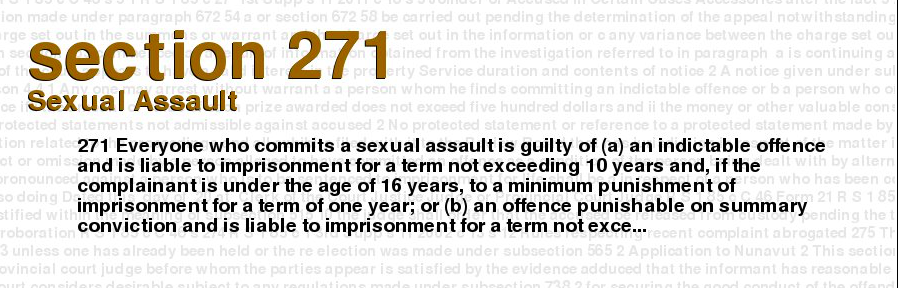
In Reginav. Donnelly, 2018 ONCA 575 (CanLII), the Ontario Court of Appeal set aside the accused’s conviction for sexual assault and ordered a new trial. In this case, the complainant was a woman who had been forced into the sex trade. This complainant had testified that she went along with oral and protected vaginal sex, but that during intercourse, the accused performed certain acts, and removed his condom and continued vaginal intercourse without her consent. According to the complainant, during the sexual intercourse the appellant pulled a strap-on out of his drawer and asked if they could use it. The complainant said that she told the appellant no but he proceeded to penetrate her with it. Further she testified that the appellant removed his condom and continued vaginal intercourse, despite the fact that she had told him to keep the condom on.
The accused/appellant flatly denied these allegations. In his testimony, the appellant admitted to the oral and protected vaginal sex, but denied that they had sex without a condom or that he used a strap-on. He also denied ejaculating into the complainant’s vagina but testified that he ejaculated onto her face with her permission. Typically, such evidence would warrant the application of the use of the legal test in Regina v. W(d), [1991] 1 SCR 742, 1991 CanLII 93 (SCC) where ideally, the appropriate instructions on the issue of credibility should be given, not only during the main charge, but on any recharge. A trial judge might well instruct the jury on the question of credibility along these lines:
First, if you believe the evidence of the accused, obviously you must acquit.
Second, if you do not believe the testimony of the accused but you are left in reasonable doubt by it, you must acquit.
Third, even if you are not left in doubt by the evidence of the accused, you must ask yourself whether, on the basis of the evidence which you do accept, you are convinced beyond a reasonable doubt by that evidence of the guilt of the accused.
On appeal, the accused argued that the trial judge erred by placing the defence of honest but mistaken belief to the jury, since it was entirely inconsistent with his testimony denying that the acts in question took place. The court of appeal agreed with that argument because there was “no air of reality” to that defence. An “air of reality” was defined by the Supreme Court of Canada, in the following way in Reginav. Cinous, [2002] 2 SCR 3, 2002 SCC 29(CanLII):
“A defence should be put to a jury if, and only if, there is an evidential foundation for it. A trial judge must thus put to the jury all defences that arise on the facts, whether or not they have been specifically raised by an accused, but he has a positive duty to keep from the jury defences lacking an evidential foundation — or air of reality. This is so even if the defence is the only defence open to the accused. The air of reality test imposes a burden on the accused that is merely evidential, rather than persuasive. In applying the air of reality test, a trial judge considers the totality of the evidence, and assumes the evidence relied upon by the accused to be true. The threshold determination by the trial judge is not aimed at deciding the substantive merits of the defence. That question is reserved for the jury. The trial judge does not make determinations about the credibility of witnesses, weigh the evidence, make findings of fact, or draw determinate factual inferences. Nor is the air of reality test intended to assess whether the defence is likely to succeed at the end of the day. The question for the trial judge is whether the evidence discloses a real issue to be decided by the jury, and not how the jury should ultimately decide the issue.”
Furthermore, the manner in which it was put to the jury obscured the accused’s actual defence and position on what happened. The trial judge misstated the accused’s position by telling the jury that the accused honestly believed that the complainant had consented to the acts in question when he clearly testified that the acts did not take place. The charge would only serve to confuse the jury and a new trial was needed.
Being charged with a serious, violent crime like sexual assault, may call for the assistance of an Criminal Defence lawyer in Alberta or other provinces in Canada. A lawyer will review all the evidence about the alleged sexual assault; and advise his or her client on how best to fight any charges. If the accused was not taken into custody according to the letter of the law, a lawyer might be able to have the charges dropped. An accused client has the right to mount an aggressive defense with the knowledge that it is incumbent upon the Crown to prove guilt beyond a reasonable doubt.
If you have been charged with a sexual assault offence under the Criminal Code of Canada, contact Mr. J.S. Patel, Calgary Criminal Lawyer for an initial free consultation at 403-585-1960.
Criminal Lawyer in Calgary and Toronto, DUI, Over 80, Domestic Assault, Sexual Assault, Murder, Legal Aid,