Tag Archives: First Nations sexual assault charges

Parole (in)eligibility on First Degree Murder Matters

The imposition of consecutive parole (in)eligibility was considered in Regina v. Bissonnette, 2022 SCC 23, the Supreme Court of Canada addressed the constitutionality of s.745.51 of the Criminal Code. Section 745.51 authorizes the imposition of consecutive parole ineligibility periods in cases involving multiple murders. In the context of first (1st) degree murders, the application of this provision permits a court to add up parole ineligibility periods of twenty-five (25) years for each murder. In a unanimous decision, the court held that s.745.51 is contrary to s.12 of the Charter (right not to be subjected to cruel and unusual treatment or punishment) and is not saved under s.1.  The Court stated the following with respect to s. 12 of the Charter.  

Supreme Court of Canada unanimously strikes down life without parole.

Section 12 of the Charter guarantees the right not to be subjected to any cruel and unusual treatment or punishment. In essence, the purpose of s. 12 of the Charter is to protect human dignity and ensure respect for the inherent worth of each individual. The protection afforded by s. 12 has two (2)  prongs. Section 12 protects, first, against the imposition of a punishment that is so excessive as to be incompatible with human dignity and, second, against the imposition of a punishment that is intrinsically incompatible with human dignity. The first prong of the s. 12 guarantee relates to punishment whose effect is grossly disproportionate to what would have been appropriate. The second prong of the protection afforded by s. 12 concerns a narrow class of punishments that are cruel and unusual by nature; these punishments will always be grossly disproportionate because they are intrinsically incompatible with human dignity.  

A punishment is cruel and unusual by nature if the court is convinced that, having regard to its nature and effects, it could never be imposed in a manner consonant with human dignity in the Canadian criminal context. To determine whether a punishment is intrinsically incompatible with human dignity, the court must determine whether the punishment is, by its very nature, degrading or dehumanizing. The effects that the punishment may have on all offenders on whom it is imposed can also inform the court and provide support for its analysis of the nature of the punishment. A punishment that is cruel and unusual by nature must always be excluded from the arsenal of punishments available to the state. It follows that the mere possibility that a punishment that is cruel and unusual by nature may be imposed is enough to infringe s. 12 of the Charter.  The court declared the provision to be of no force or effect immediately under s.52(1) of the Constitution Act, 1982. The court held that the declaration strikes down the provision retroactively to the date it was enacted.

J. S. Patel, Criminal Defence Lawyer

If you have been charged with a criminal offence, call Mr. J.S. Patel, Barrister for a free telephone consultation at 403-585-1960 or 647-323-1960.
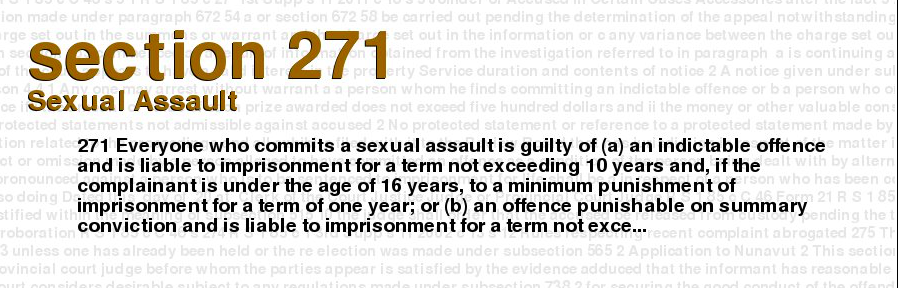
An error of putting a defence of a “mistaken belief” to consent in a sexual activity to a jury could led to adverse results for an accused that ought to be overturned on an appeal when there was no “air of reality” to the defence. 

Sexual assault charges
Defence in mistaken belief in consent for sexual assault

In Reginav. Donnelly, 2018 ONCA 575 (CanLII), the Ontario Court of Appeal set aside the accused’s conviction for sexual assault and ordered a new trial. In this case, the complainant was a woman who had been forced into the sex trade.  This complainant had testified that she went along with oral and protected vaginal sex, but that during intercourse, the accused performed certain acts, and removed his condom and continued vaginal intercourse without her consent.  According to the complainant, during the sexual intercourse the appellant pulled a strap-on out of his drawer and asked if they could use it. The complainant said that she told the appellant no but he proceeded to penetrate her with it. Further she testified that the appellant removed his condom and continued vaginal intercourse, despite the fact that she had told him to keep the condom on.


The accused/appellant flatly denied these allegations.   In his testimony, the appellant admitted to the oral and protected vaginal sex, but denied that they had sex without a condom or that he used a strap-on. He also denied ejaculating into the complainant’s vagina but testified that he ejaculated onto her face with her permission. Typically, such evidence would warrant the application of the use of the legal test in Regina v. W(d), [1991] 1 SCR 742, 1991 CanLII 93 (SCC) where ideally, the appropriate instructions on the issue of credibility should be given, not only during the main charge, but on any recharge. A trial judge might well instruct the jury on the question of credibility along these lines:


First, if you believe the evidence of the accused, obviously you must acquit.


Second, if you do not believe the testimony of the accused but you are left in reasonable doubt by it, you must acquit.


Third, even if you are not left in doubt by the evidence of the accused, you must ask yourself whether, on the basis of the evidence which you do accept, you are convinced beyond a reasonable doubt by that evidence of the guilt of the accused.


On appeal, the accused argued that the trial judge erred by placing the defence of honest but mistaken belief to the jury, since it was entirely inconsistent with his testimony denying that the acts in question took place. The court of appeal agreed with that argument because there was “no air of reality” to that defence.  An “air of reality” was defined by the Supreme Court of Canada, in the following way in Reginav. Cinous, [2002] 2 SCR 3, 2002 SCC 29(CanLII):


“A defence should be put to a jury if, and only if, there is an evidential foundation for it.  A trial judge must thus put to the jury all defences that arise on the facts, whether or not they have been specifically raised by an accused, but he has a positive duty to keep from the jury defences lacking an evidential foundation — or air of reality.  This is so even if the defence is the only defence open to the accused.  The air of reality test imposes a burden on the accused that is merely evidential, rather than persuasive.  In applying the air of reality test, a trial judge considers the totality of the evidence, and assumes the evidence relied upon by the accused to be true.  The threshold determination by the trial judge is not aimed at deciding the substantive merits of the defence.  That question is reserved for the jury.  The trial judge does not make determinations about the credibility of witnesses, weigh the evidence, make findings of fact, or draw determinate factual inferences.  Nor is the air of reality test intended to assess whether the defence is likely to succeed at the end of the day.  The question for the trial judge is whether the evidence discloses a real issue to be decided by the jury, and not how the jury should ultimately decide the issue.”


Furthermore, the manner in which it was put to the jury obscured the accused’s actual defence and position on what happened. The trial judge misstated the accused’s position by telling the jury that the accused honestly believed that the complainant had consented to the acts in question when he clearly testified that the acts did not take place. The charge would only serve to confuse the jury and a new trial was needed.


Being charged with a serious, violent crime like sexual assault, may call for the assistance of an Criminal Defence lawyer in Alberta or other provinces in Canada. A lawyer will review all the evidence about the alleged sexual assault; and advise his or her client on how best to fight any charges. If the accused was not taken into custody according to the letter of the law, a lawyer might be able to have the charges dropped. An accused client has the right to mount an aggressive defense with the knowledge that it is incumbent upon the Crown to prove guilt beyond a reasonable doubt.


If you have been charged with a sexual assault offence under the Criminal Code of Canada, contact Mr. J.S. Patel, Calgary Criminal Lawyer for an initial free consultation at 403-585-1960.