Refusal to Provide a Breath Sample. Call Mr. J. S. Patel, Criminal Lawyer at 403-585-1960 for a consultation.
In Regina v. Suter, 2018 SCC 34, a 6:1 majority of the Supreme Court of Canada allowed the accused’s appeal in part. The Court set aside his 26-month sentence of imprisonment, imposed by the lower sentencing court, for the offence of refusing to provide a breath sample knowing that he caused an accident resulting in a death (Criminal Code, s.255(3.2)),and imposed a sentence of time served of just over ten (10) and a (1/2) half months.
That said, the circumstances of this case are unique as related recently on CBC news. The fatal accident was caused by a non-impaired driving error, and Mr. Suter refused to provide the police with a breath sample because he received bad legal advice. The lawyer he called from the police station expressly told him not to provide a breath sample, and Mr. Suter demurred. Added to this, sometime after the accident, Mr. Suter was attacked by a group of vigilantes who used a set of pruning shears to cut off his thumb. His wife was also attacked in a separate incident. He later pleaded guilty to the s.255(3.2) offence and the other charges were withdrawn.
The sentencing judge imposed a sentence of four (4) months’ imprisonment plus a thirty (30) month driving prohibition. The Judge found that the accident was caused by a non-impaired driving error. He also found that the accused’s refusal to provide a breath sample was the result of bad legal advice and was a mistake of law, which fundamentally changed the accused’s moral culpability. In addition, he noted several other mitigating factors, and also took into account the violent vigilante actions against the accused. However, the Court of Appeal, the Court of Appeal disagreed with this sentence. The Appeal court increased the custodial portion of the sentence to twenty-six (26) months. The court found that: the deficient legal advice did not constitute a mistake of law and it could not be used to mitigate the accused’s sentence; the sentencing judge failed to consider, as an aggravating factor, that the accused chose to drive while distracted in the context of his health and pre-existing alcohol problems; and the sentencing judge erred by taking the vigilante violence into account.
The majority of the Supreme Court held that both the sentencing judge and the Court of Appeal committed errors in principle that resulted in the imposition of unfit sentences. The majority held as follows:
The Court of Appeal erred by effectively sentencing the accused for the uncharged offence of careless driving or dangerous driving causing death. A further error was committed by the Court of Appeal in failing to consider the vigilante violence suffered by the accused. The majority stated that vigilante violence against an offender for his or her role in the commission of an offence is a collateral consequence that should be considered — to a limited extent — when crafting an appropriate sentence.
What is more, the sentencing judge erred in finding that the accused was acting under a mistake of law when he refused to provide the police with a breath sample and that this factor fundamentally changed the accused’s moral culpability. He also erred in giving undue weight to the accused’s non-impairment as a mitigating factor.
Taking into account the attenuating factors in the case, the majority of the Supreme Court of Canada concluded that a sentence of 15 to 18 months’ imprisonment would have been a fit sentence at the time of sentencing. The majority held, however, that in the circumstances of this case – the accused had already served just over 10 and a half months of his custodial sentence and had spent almost nine months waiting for the court’s decision – it would not be in the interests of justice to re-incarcerate the accused.
The final dissenting opinion came from Justice Gascon. His decision was predicated on principles of deference towards the sentencing judge. Justice Gascon would have set aside the 26-month sentence of imprisonment imposed by the Court of Appeal and restored the four-month sentence imposed by the sentencing judge. Gascon J. held that there was no legal basis to justify appellate intervention with the initial sentence in the case.
Dangerous Driving Under the Criminal Code of Canada
By way of a simple and general summary of legal information, a restatement of the elements of the dangerous driving offence was provided in Regina v. Beatty, 2008 SCC 5, and Roy, 2012 SCC 26, with a significantly greater emphasis placed on the mental element of the offence and criminal blameworthiness. In Beatty, above, while confirming that the offence does not require subjective mens rea, Charron J., on behalf of the majority, provided for the application of the “modified objective test”, per Regina v. Hundal, 1993 CanLII 120 (S.C.C.), so as to ensure that punishment is imposed only upon those with “a blameworthy state of mind”. To that end, Charron J. held that the assessment of whether the accused’s conduct is a “marked departure” from the norm, is not an aspect of the actus reus, but of the mens rea. Accordingly, an evidentiary burden does not shift to the accused from the Crown’s presentation of a case of objectively dangerous driving – the actus reus. A further determination must be made whether the Crown has proven that the conduct involved a marked departure from the standard of care of a reasonable person in the circumstances that is deserving of punishment – the mens rea. Moreover, it remains open to the defence to raise a reasonable doubt that a reasonable person in the position of the accused would not have been aware of the risk posed by the manner of driving or, alternatively, would not have been able to avoid creating the danger.
In Reginav. Laverdure, 2018 ONCA 614(RD), the Ontario Court of Appeal(“OCA”) allowed the accused’s conviction appeal for dangerous driving causing death and ordered a new trial. The main reason for over-turning the conviction was due to the trial judges failure to analyze the fault component of the legal test.
In that case accused struck and killed a pedestrian who had crossed the road after attending a hockey game at a local arena in Pembroke, Ontario. At appeal, the accused argued that the trial judge made unreasonable findings of fact and that he erred in his analysis of the elements of the offence. The test for dangerous driving under the Criminal Code of Canada (the “Code”) is stated in Section 249 of the Code.; and the legal test has been considered in Reginav. Roy, 2012 SCC 26 (CanLII), [2012] 2 S.C.R. 60, at para. 30; R. v. Reynolds, [2013] ONCA 433, at para. 18.
The court upheld the trial judge’s findings of fact with respect to the accused’s driving speed. Evidence from the accident reconstructionist, several witness, as well as forensic evidence supported the conclusion that he was driving “at a high rate of speed on a city street” (at para. 17). The court further upheld the finding that the circumstances as they existed on the road at the time (large groups of pedestrians crossing the road and walking along it) called for drivers to slow down and proceed cautiously.
It was open to the trial judge to find that the actus reus was established; and that he did not reason backwards from the accident (at paras. 20-22). However, while the Trial Judge correctly identified the proper test for the mens reaof the offence, the trial judge failed to identify “how and in what way” the accused’s driving went beyond negligence or carelessness to a marked departure from the standard of care that a reasonable person would show in the same position. This was not a case where the manner of driving was so egregious as to satisfy the fault element without any additional analysis of the evidence. At paragraph 25, the Court of Appeal stated:
Rather, the trial judge appears to have concluded that the act of driving dangerously necessarily constituted what he referred to as a “marked departure from what a reasonable person would expect in the circumstances”. He did not identify the “how and in what way” the appellant’s driving went beyond negligence or carelessness and reached the level of a marked departure from the standard of care that a reasonable person would show in the same position.
If you have been charged with a Criminal Code Offence under Section 249 (i.e. Dangerous Operation of the Motor Vehicle), call Mr. J.S. Patel, Criminal Lawyer, for a free consultation.
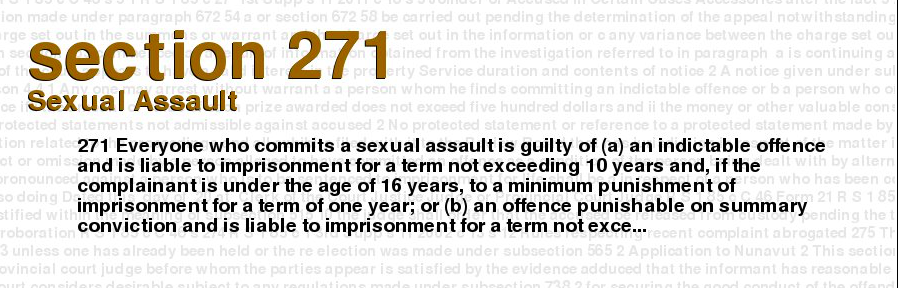
Defence in mistaken belief in consent for sexual assault
In Reginav. Donnelly, 2018 ONCA 575 (CanLII), the Ontario Court of Appeal set aside the accused’s conviction for sexual assault and ordered a new trial. In this case, the complainant was a woman who had been forced into the sex trade. This complainant had testified that she went along with oral and protected vaginal sex, but that during intercourse, the accused performed certain acts, and removed his condom and continued vaginal intercourse without her consent. According to the complainant, during the sexual intercourse the appellant pulled a strap-on out of his drawer and asked if they could use it. The complainant said that she told the appellant no but he proceeded to penetrate her with it. Further she testified that the appellant removed his condom and continued vaginal intercourse, despite the fact that she had told him to keep the condom on.
The accused/appellant flatly denied these allegations. In his testimony, the appellant admitted to the oral and protected vaginal sex, but denied that they had sex without a condom or that he used a strap-on. He also denied ejaculating into the complainant’s vagina but testified that he ejaculated onto her face with her permission. Typically, such evidence would warrant the application of the use of the legal test in Regina v. W(d), [1991] 1 SCR 742, 1991 CanLII 93 (SCC) where ideally, the appropriate instructions on the issue of credibility should be given, not only during the main charge, but on any recharge. A trial judge might well instruct the jury on the question of credibility along these lines:
First, if you believe the evidence of the accused, obviously you must acquit.
Second, if you do not believe the testimony of the accused but you are left in reasonable doubt by it, you must acquit.
Third, even if you are not left in doubt by the evidence of the accused, you must ask yourself whether, on the basis of the evidence which you do accept, you are convinced beyond a reasonable doubt by that evidence of the guilt of the accused.
On appeal, the accused argued that the trial judge erred by placing the defence of honest but mistaken belief to the jury, since it was entirely inconsistent with his testimony denying that the acts in question took place. The court of appeal agreed with that argument because there was “no air of reality” to that defence. An “air of reality” was defined by the Supreme Court of Canada, in the following way in Reginav. Cinous, [2002] 2 SCR 3, 2002 SCC 29(CanLII):
“A defence should be put to a jury if, and only if, there is an evidential foundation for it. A trial judge must thus put to the jury all defences that arise on the facts, whether or not they have been specifically raised by an accused, but he has a positive duty to keep from the jury defences lacking an evidential foundation — or air of reality. This is so even if the defence is the only defence open to the accused. The air of reality test imposes a burden on the accused that is merely evidential, rather than persuasive. In applying the air of reality test, a trial judge considers the totality of the evidence, and assumes the evidence relied upon by the accused to be true. The threshold determination by the trial judge is not aimed at deciding the substantive merits of the defence. That question is reserved for the jury. The trial judge does not make determinations about the credibility of witnesses, weigh the evidence, make findings of fact, or draw determinate factual inferences. Nor is the air of reality test intended to assess whether the defence is likely to succeed at the end of the day. The question for the trial judge is whether the evidence discloses a real issue to be decided by the jury, and not how the jury should ultimately decide the issue.”
Furthermore, the manner in which it was put to the jury obscured the accused’s actual defence and position on what happened. The trial judge misstated the accused’s position by telling the jury that the accused honestly believed that the complainant had consented to the acts in question when he clearly testified that the acts did not take place. The charge would only serve to confuse the jury and a new trial was needed.
Being charged with a serious, violent crime like sexual assault, may call for the assistance of an Criminal Defence lawyer in Alberta or other provinces in Canada. A lawyer will review all the evidence about the alleged sexual assault; and advise his or her client on how best to fight any charges. If the accused was not taken into custody according to the letter of the law, a lawyer might be able to have the charges dropped. An accused client has the right to mount an aggressive defense with the knowledge that it is incumbent upon the Crown to prove guilt beyond a reasonable doubt.
If you have been charged with a sexual assault offence under the Criminal Code of Canada, contact Mr. J.S. Patel, Calgary Criminal Lawyer for an initial free consultation at 403-585-1960.
Guilty pleas, striking or vacating a guilty plea in Canada.
“Simply put, pleading guilty is the decision of the accused, not a reasonable accused, or someone like the accused.”
In Regina v. Wong, 2018 SCC 25, a 4:3 majority of the Supreme Court of Canadaheld that when an accused person seeks to withdraw a guilty plea on the basis that he or she did not appreciate the consequences of that plea, he or she must establish subjective prejudice.
The Supreme Court said that an Accused person who seeks to withdraw their guilty plea on the basis that they were unaware of legally relevant consequences at the time of the plea should be required to establish subjective prejudice. To that end, the accused must file an affidavit establishing a reasonable possibility that he or she would have either (1) opted for a trial and pleaded not guilty; or (2) pleaded guilty, but with different conditions.
Because the original guilty plea is an exercise of the accused’s own subjective judgment, it logically follows that the test for withdrawing that plea should also be directed to the accused’s subjective judgment. The inquiry is subjective to the accused, but allows for an objective assessment of the credibility of the accused’s subjective claim. Ultimately, what matters is the accused’s decision to plead guilty or to proceed to trial, and not whether that decision is, to someone else, reckless or irrational. This framework is premised upon the view that judicial scrutiny must be directed to how the accused, and no one else, would have proceeded. But like all credibility determinations, the accused’s claim about what his or her subjective and fully informed choice would have been is measured against objective circumstances. Courts should therefore carefully scrutinize the accused’s assertion, looking to objective, circumstantial evidence to test its veracity against a standard of reasonable possibility. This approach strikes the proper balance between finality of guilty pleas and fairness to the accused. The accused need not show a viable defence to the charge in order to withdraw a plea on procedural grounds and requiring the accused to articulate a route to an acquittal is antithetical to the presumption of innocence and to the subjective nature of choosing to plead guilty.”
The accused, Mr. Wong, is a permanent resident, had pleaded guilty to cocaine trafficking and was sentenced to nine (9) months’ imprisonment without realizing this would automatically make him inadmissible to Canada and prevent him from appealing the inadmissibility. The majority from the Supreme Court held that the accused’s had filed an affidavit that failed to indicate that he would have proceeded differently had he known of the collateral immigration consequences and that therefore the plea could not be withdrawn. However, the Crown conceded a sentence of six (6) months less a day was appropriate and this would restore the accused’s right to appeal his inadmissibility.
The three-member dissent would have used a “modified objective” test: whether a reasonable person in the same situation as the accused would have proceeded differently had he or she been aware of the collateral consequences. The dissent stated:
The dissent’s modified objective approach to determine whether an accused has shown prejudice would not account for the fundamentally subjective and deeply personal nature of the decision to plead guilty. Pleading guilty is the decision of the accused, not a reasonable accused, or someone like the accused. To permit reviewing courts to substitute their own view of what someone in the accused’s circumstances would have done is to run a serious risk of doing injustice to that accused. A modified objective framework focusses upon what a judicially constructed hypothetical person would do, instead of how the particular accused would have proceeded. Furthermore, this approach would likely be difficult for lower courts to apply. Given the highly contextual and even idiosyncratic nature of factors that influence important decisions, adopting a standard based on what a hypothetical reasonable person who need not be presumed to have taken the best or single most rational course of action would have done effectively confers upon reviewing courts unbounded discretion to reach whatever conclusion they see fit. The modified objective framework also adopts a variable standard of scrutiny, not tied to a particular accused, but rather to a reasonable person. However, different accused, even different similarly situated accused, may ascribe varying levels of significance to different collateral consequences. Thus, a modified objective approach risks resulting in vacated guilty pleas even where there is no evidence that the accused personally would have done something differently. Even further, an accused who admits under cross‑examination that he or she would have proceeded identically would still be entitled to withdraw his or her plea if a reasonable accused in his or her circumstances would withdraw the plea. This would impose unnecessary and substantial demands on a criminal justice system that is already overburdened.
This case illustrates the importance of ensuring that sufficient representations are made to a court when an application is made to vacate a guilty plea. If you are facing similar circumstances, call Mr. J.S. Patel, Criminal Lawyer at 403-585-1960.
If you have been convicted of a Criminal Code offence or of an offence under an Act of Parliament resulting in a jail term, an application can be made to secure judicial interim release (i.e. Bail) pending the outcome of your appeal.
It is critical to note, that the criminal law standards for securing bail are elevated, primarily due to the loss of the presumption of innocence due to the entry of the conviction. Section 679(3) of the Criminal Code allows a judge of a court of appeal to order the release of an offender who has appealed his (or her) conviction “if the appellant establishes that (a) the appeal … is not frivolous; (b) he will surrender himself into custody in accordance with the terms of the order; and (c) his detention is not necessary in the public interest.” There are two (2) components to the last criterion. The offender must establish that he or she is not a threat to public safety – the offender will not commit a criminal offence while on bail – and that a reasonable person who is thoughtful, dispassionate, informed and respectful of society’s fundamental values would not lose confidence in the administration of justice if the appeal court released the applicant.
In determining the public interest involves the balancing of great many factors. Some were listed in Regina v McNaughton, 2010 ABCA 97at para. 12, 26 Alta LR (5th) 126:
Without attempting to compile a complete list, some of the factors that are relevant to the exercise of the jurisdiction include:
ensuring fairness in the appeal process, to avoid the prospect of the applicant serving a sentence when the appeal is ultimately allowed (Charter of Rights, s. 11(e); Farinacciat paras. 43, 48; v. Fox, 2000 ABCA 283, 8 M.V.R. (4th) 1 at paras. 18-9; R. v. Colville, 2003 ABCA 133, 327 A.R. 143 at para. 12);
the fact of conviction, and the public importance of respecting the trial decision and the trial process (Nguyen[ (1997), 97 BCAC 86, 119 CCC (3d) 269] at para.18; Farinacciat para. 41; v. Rhyason, 2006 ABCA 120, 57 Alta. L.R. (4th) 31, 208 C.C.C. (3d) 193);
the apparent strength of the grounds for appeal, recognizing that it is not the role of the bail judge to resolve the merits ( v. Heyden(1999), 127 O.A.C. 190, 141 C.C.C. (3d) 570 at paras. 7-8, 12; Rhyasonat paras. 13-18; Colvilleat para. 16);
the standard of review that will be applied by the appeal court ( v. Sagoo, 2009 ABCA 357, 464 A.R. 258 at para. 9);
any risk that the applicant will reoffend if released (Nguyenat para. 7; Foxat paras.18, 20-21);
the applicant’s history of compliance with court orders and legally imposed conditions;
whether the applicant was released pending trial, and if so if his release was uneventful;
whether conditions of release could be crafted that would protect the public interest;
the seriousness of the charges, reflected in the severity of the sentence, although no class of offence is excluded from release (Nguyenat paras. 13, 20-24; Heydenat para. 12; v. R.D.L.(1995), 178 A.R. 142 at para. 5);
the effect on the perception of the administration of justice if the applicant is released, including the perception of an informed and reasonable member of society (Nguyenat paras. 25-6; Rhyasonat para. 20; Foxat para. 18; Colvilleat para. 17);
the status and state of readiness of the appeal (Farinacciat paras. 44, 48; Heydenat para. 12; D.L.at paras. 5, 12).
The Court of Appeal has recently considered two (2) cases that have considered the recent application of this rule: R. v. C.L, infra, and R. v. B.G. Each are discussed below:
Regina v. C.L, infra
The Ontario of Court of Appeal dismissed the accused’s application for bail pending appeal. Following a judge-alone trial, the accused in this case was convicted of sexual assault and being unlawfully in a dwelling house. As a consequence of the conviction and the outcome of the sentencing hearing, this accused person received a sentence of two (2) years less a day imprisonment plus two (2) years of probation. His application for bail pending appeal was dismissed. In dismissing the accused’s application, Trotter J.A. held that the public interest criterion was not met. This was because “[t]he materials filed fail to demonstrate that the grounds of appeal have sufficient strength to overcome the serious enforceability considerations present in this case” (at para. 21).
The Ontario Court of Appeal took umbrage with accused’s new charges of breach of recognizance, combined with his failure to mention them in his bail pending appeal affidavits. The Court stated that it did not inspire confidence about compliance with any bail pending appeal order that might be made. Justice Trotter stated as follows (at para. 13): “The new criminal charges should have been disclosed. Judges of this court rely heavily on the trustworthiness of affidavits sworn in support of bail pending appeal applications. They are expected to be both accurate and completeRegina v. B.G, Infra,
In Regina and B.G., 2018 ONCA 455 (RD), Justice Brown of the Ontario Court of Appeal, granted the accused’s application for bail pending appeal from his conviction for child pornography and sexual offences. The trial judge found that the accused had taken and distributed photographs depicting his young daughter naked. The Crown opposed the application on the grounds that the public interest criterion was not met. The public interest criterion in s. 679(3)(c) of the Criminal Code consists of two components: public safety and public confidence in the administration of justice:R v. Oland, 2017 SCC 17, [2017] 1 S.C.R. 250, at paras. 23 & 26. The public confidence criterion requires balancing several factors: the seriousness of the offence; the strength of the grounds of appeal; public safety; and flight risks: Oland, at paras. 37-
Justice Brown held as follows:
[12] The offences of which the applicant was convicted are very serious, involving as they do a vulnerable young child. However, when that factor is weighed with the remaining factors under the Oland public interest test – the strength of the grounds of appeal, no flight risk, and no threat to public safety – on balance, reviewability is favoured over enforceability.
“The offences of which the applicant was convicted are very serious, involving as they do a vulnerable young child. However, when that factor is weighed with the remaining factors under the Oland public interest test – the strength of the grounds of appeal, no flight risk, and no threat to public safety – on balance, reviewability is favoured over enforceability.”
These cases demonstrate the importance of the benefits of a properly prepared bail application (affidavits and arguments). The procedure in securing bail prior to trial differs markedly when a conviction has been entered and a person has been remanded into custody.
If you have been convicted of a criminal code offence and you are seeking bail, contact Mr. J.S. Patel, Barrister at 403-585-1960 to secure a telephone consultation.
Failure to Provide the Necessities of Life. Elements of the Offence and the sufficiency of a jury charge.
The parents of the deceased child had their conviction for the failure to provide the necessities of life for their (deceased) child overturned by the Supreme Court of Canada (the “SCC”) recently. In Regina v. Stephan, 2018 SCC 21, the SCC overturned the a ruling from the Alberta Court of Appeal and adopted reasoning of Justice O’Ferrall’s dissent.
The facts in this case were extremely unfortunate. The majority of the panel at the Alberta Court of Appeal restated the facts in the following terms:
[2] The appellants’ son, Ezekiel, was born in August 2010. On February 27, 2012, Ezekiel began to exhibit signs of illness while at pre-school. Symptoms included fever, decreased appetite, and trouble breathing and swallowing.
[3] Both parents were concerned. Rather than take him to a medical clinic, however, they contacted a family friend, a nurse, by telephone. After listening to Ezekiel’s breathing over the phone, the friend thought the problem might be croup. The appellants treated Ezekiel with fresh air, fluids, humidity and natural supplements including garlic, olive leaf extract and Methylsulonylmethane.
[4] Over the next few days, Ezekiel’s fever abated but he still felt hot. He continued to have a decreased appetite, low energy, decreased activity, and trouble breathing.
[5] By March 5, the appellants felt Ezekiel’s condition had improved as he no longer had trouble breathing, and he returned to pre-school. DavidStephanwent out of town to work.
[6] A day later, March 6, Ezekiel was weaker. He was less responsive; he stayed in bed and moaned. He tugged at his diaper and rubbed his face, both movements that seemed to ColletStephanto be involuntary. ColletStephanlooked online for a possible explanation and phoned DavidStephanto report that Ezekiel seemed to be getting sick again.
[7] DavidStephanreturned from work on March 8 with some natural products he had picked up while away. Ezekiel was fed apple cider vinegar, onion powder, ginger root, garlic, hot peppers and horseradish root. Over the next few days, Ezekiel’s condition appeared to improve, although he began to show signs of stiffness or joint tension.
[8] Between March 9 and 12, the stiffness increased and Ezekiel’s back began to arch. He refused food, and his lethargy and weakness increased. His parents were worried.
[9] On March 12, DavidStephanwent to a business meeting. ColletStephanphoned a nurse friend to ask her to examine Ezekiel. Collet told her husband about her concerns when he came home for lunch.
[10] The family friend examined Ezekiel and suggested the problem might be meningitis. She suggested that Ezekiel be taken to the doctor. Rather than following that advice, ColletStephansearched the internet seeking information about meningitis. Based upon the information she obtained, ColletStephantried the Brudzinski and Kernig tests for meningitis. The tests involve physical manipulation of the child’s head or legs. Ezekiel tested positive on both, but Collet concluded Ezekiel had viral meningitis, rather than the more serious form of bacterial meningitis. ColletStephancommunicated her conclusions to her husband when he returned from a second business meeting that day.
[11] DavidStephanstayed home the following day, March 13,to help and to take ColletStephanto Lethbridge to sign some documents. Before leaving for Lethbridge, ColletStephancontacted a naturopathic clinic to get some advice about boosting Ezekiel’s immune system because he had meningitis. The receptionist told her to take Ezekiel to a doctor.
[12] The appellants proceeded to Lethbridge with Ezekiel lying on a bed in the back of their vehicle because he could no longer sit comfortably in his car seat. After dealing with their lawyer, the appellants went to the naturopathic clinic to purchase an echinacea tincture called Blast. They administered this to Ezekiel, went shopping, and then returned home.
[13] That evening, Ezekiel began exhibiting difficulty breathing. About 9:00 p.m., after ColletStephanhad returned from a meeting, Ezekiel stopped breathing. DavidStephanphoned his father AnthonyStephanand then 911.
[14] ColletStephangot Ezekiel breathing again by slapping him on the back and then giving him a few rescue breaths. DavidStephanphoned 911 to call off the ambulance saying they would bring Ezekiel to the hospital by car. The family left 20 minutes later for the Cardston hospital but before they arrived, Ezekiel again stopped breathing. ColletStephanperformed CPR while DavidStephandrove on and phoned 911. They were met by an ambulance outside of Cardston.
[15] The responders began performing CPR but they had difficulty securing an airway due to a lack of proper equipment. This deficiency lasted eight minutes until just before the ambulance reached the hospital in Cardston.
[16] Ezekiel was treated at the Cardston hospital and then transferred to Lethbridge in order to be taken by STARS air ambulance to the Children’s Hospital in Calgary. He never regained consciousness. On March 15 and 16, Ezekiel was neurologically assessed and determined to be brain-dead. Life sustaining therapies were discontinued and on March 18, 2012, Ezekiel died.
However, Justice O’Ferrall said the following about the facts of the case, in his dissent:
[211] On the facts of this case, it cannot be argued that the Stephans were not devoted and loving parents. They did not neglect their 18-month old son’s symptoms when he exhibited them. They did not fail to provide him with what they thought were the necessaries of life. They monitored him closely when he became ill, doing what they believed was best for him. There is no doubt the decisions they made with respect to the well-being of their son turned out to be terribly wrong, but it is not clear that their acts or omissions were criminal in the sense of deserving of punishment for moral blameworthiness.
[212] That said, a jury of their peers did find the Stephans guilty of failing to provide the necessaries of life to their son, contrary to section 215(2)(a)(ii) of the Criminal Code. However, as argued by the appellants, the trial judge’s charge to the jury was problematic, perhaps to the point of impacting the fairness of the trial. At the very least, the jury charge was confusing, misleading, and deficient in describing a key element of the offence. Furthermore, the trial judge did not properly instruct the jury on the fault element or the mens rea of the offence. The cumulative effect of the jury instructions may have been an unsafe or suspect verdict.
The SCC accepted Justice O’Ferrall’s reasoning that in sum, the trial judge failed in his jury charge for three (3) reasons:
(1)The Trial Judge he did not adequately explain what the jury’s focus should have been in determining whether there had been a failureunder the second element of the offence. The full legal test, outlining the elements of the offence, was explained in Reginav F,2008 SCC 60 (CanLII) at paras 66-67, [2008] 3 SCR 215:
The actus reus of failing to provide the necessaries of life will be established if it is proved (1) that the accused was under a legal duty to provide the necessaries of life to the person in question pursuant to s. 215(1)(a); (2) that, from an objective standpoint, he or she failed to perform the duty; and (3) that, again from an objective standpoint, this failure endangered the life of the person to whom the duty was owed, or caused or was likely to cause the health of that person to be endangered permanently. Following Charron J.’s reasoning in R. v. Beatty, [2008] 1 S.C.R. 49, 2008 SCC 5 (CanLII), the marked departure standard is not applied at this point, since “[n]othing is gained by adding to the words of [the statute] at this stage of the analysis” (para. 45).
The mens rea of failing to provide the necessaries of life will be established if it is proved that the conduct of the accused represented a marked departure from the conduct of a reasonable parent, foster parent, guardian or family head in the same circumstances.
Each of the four elements specified in the above test (the three elements of the actus reus plus the mens rearequirement) must be proven in order to obtain a conviction. It was important for the jury to keep these four distinct elements in mind. However, the trial judge, in his charge to the jury, combined two of them.
Secondly, the trial judge appeared to incorrectly assume the third (3rd) element of the offence had already been met in instructing the jury on the second (2nd) element of the offence. The trial judge made the following comments to the jury in this case:
In deciding whether the Crown has proven beyond a reasonable doubt that David Stephan failed to provide necessaries of life you must determine whether the Crown has proven beyond a reasonable doubt that the conduct of David Stephan represented a marked departure from the conduct of a reasonably prudent and ordinary person where that reasonable person, in all the circumstances of David Stephan would foresee that medical attention was required to maintain Ezekiel’s life, and that reasonable person would also foresee that failing to provide the medical attention would endanger Ezekiel’s life.
This was found to be an error by Justice O’Ferral because “…he foregoing instruction seems to invite the jury to assume as true the latter half of the statement (in bold) when considering whether the conduct of the parents amounted to a failure to provide the necessaries of life. The latter half of the statement is essentially the third element of the actus reus of the offence, which is to be determined only after a failure to provide the necessaries of life has been established.”
Thirdly, the trial failed to adequately explain the mens rea element of the offence to the jury. Specifically, the Trial Judge was required to explain what constituted a “marked departure”; and this was not done. Marked departure is a difficult concept even for those with legal training and therefore requires explanation. The discussion in Regina v Beatty, 2008 SCC 5 (CanLII), [2008] 1 SCR 49 is helpful. That case dealt with the charge of dangerous driving which, like that of failing to provide the necessaries of life, requires proof of a marked departure from the standard of care of a reasonable person in order to found a conviction. The majority in Beatty explains, at paragraph 7, that:
The distinction between a mere departure and a marked departure from the norm is a question of degree. It is only when the conduct meets the higher threshold that the court may find, on the basis of that conduct alone, a blameworthy state of mind.
This case demonstrates the necessity of ensuring that the jury charge is properly examined before being put to the jury either at the trial stage or (after the fact) at the appellate stage of the criminal law proceedings. It is critical to seek the advice of a criminal trial and appeal lawyer in face serious criminal charges wherein the Crown is seeking a conviction for failure to provide for the necessities of life.
If you have been charged with a serious criminal offence, contact Mr. J.S. Patel, Criminal Lawyer for advice at 403-585-1960.
Section 7(1) of the Controlled Drugs Substances Act
The Ontario Court of Appeal upheld a decision of the Superior Court in striking down the mandatory minimums required under ‘Unauthorized Production” provisions of Section 7(1) of Controlled Drugs Substances Act (the “CDSA”). InReginaand VU, 2018 ONCA 436, the Ontario Court of Appeal considered three (3) separate sentence appeals, from three (2) accused persons who had levied a challenge, through defence counsel, to the constitutionality of the mandatory minimum sentences for marijuana production under the CDSA. Each defendants, Pham, Vu, Li, were convicted of unauthorized production of marijuana under s.7(1) of the CDSA. Criminal Defence counsel, at the sentencing stage, had filed an application under the Judicature Act to challenge the applicable mandatory minimum as contrary to s.12 of the Charter of Rights and Freedomsas cruel and unusual punishment. Each appeal is summarized below.
In the Regina v. Pham appeal, the Ontario Court of Appeal upheld the sentencing judge’s ruling (which is reported at 2016 ONSC 5312) that the two (2)-year mandatory minimum under CDSA s.7(2)(b)(v) which involves the production of more than five hundred (500) plants was contrary to s.12. That same order of juridical logic was applied to s.7(2)(b)(vi) (three-year minimum for production of more than five-hundred (500) plants where statutory aggravating factor applies. What is more, the ONCA also upheld the ruling, from the Sentencing Court, that the aggravating factor under CDSA s.7(3)(c), which is the production constituting a potential safety hazard in a residential area was unconstitutional. In considering the application of the famed Reginav. Oakes, [1986] 1 SCR 103test, the highest Court in Ontario found that none of these provisions could be saved under s.1 of the Charter. The Court stated the following in relevant part:
[83] I do not accept these submissions. With respect to ss. 7(2)(b)(vi) and 7(3)(c), they ignore the fundamental finding that this three-year mandatory minimum can apply to persons who have no moral culpability in relation to the statutory aggravating factor. The provisions could have been tailored to avoid this result. They are neither minimally impairing nor proportionate.[84] Similarly, with respect to s. 7(2)(b)(v), as the Pham sentencing judge noted, Parliament could have provided a safety valve to allow judges to grant exemptions in exceptional cases. Once again, the provisions are neither minimally impairing nor proportional.
The court also rejected the Crown’s argument, raised for the first time on appeal, that the impugned mandatory minimum provisions could be “read down” by inserting the words “if the production is for the purpose of trafficking” into each subsection.
In the Reginav. Vuappeal, the Ontario upheld Justice Durno striking down of the three (3) year minimum arising out of s.7(3)(c) of the CDSA(reported at 2015 ONSC 5834 and 2015 ONSC 7965), but set aside his ruling that the two (2) year minimum under s.7(2)(b)(v) was constitutional. The court held that its findings in the Phamappeal governed the constitutional issues in the Vu Appeal with equal force. Durno J. had also struck down the mandatory minimums under ss.7(2)(b)(i) and (ii) of the CDSA (less than 201 and more than five plants). The accused had not been charged under these sections. The Court of Appeal agreed with the Crown that it was not open to the sentencing judge to declare invalid provisions not applicable to the accused. As a result, the Crown did not have an appeal route in relation to these declarations as they did not play a role in the sentencing decision and the court did not have to consider their constitutionality.
In the Li appeal, the court reversed the sentencing judge’s ruling (reported at 2016 ONSC 1757) and held that the 12-month mandatory minimum under s.7(2)(b)(iii) of the CDSA (production of more than 200 but less than 501 plants) violated s.12 of the Charter and could not be saved under s.1. The analysis and reasonable hypotheticals from the Pham appeal applied equally to this accused. The Court concluded the case in the following terms at paragraphs 119 to 121:
[119] In summary, I would dismiss the Crown’s appeal in Pham and uphold the declarations that ss. 7(2)(b)(v), (vi) and 7(3)(c) of the CDSA are unconstitutional.
[120] I would also dismiss the Crown’s appeal in Vu. My conclusion in respect of the Pham appeal governs the constitutional arguments in relation to ss. 7(2)(b)(v), (vi) and 7(3)(c). The Crown has not demonstrated that it has an appeal route to this court relating to their ss. 7(2)(b)(i) and (ii) argument as the declarations of invalidity in relation to those sections had no impact on the sentence Mr. Vu received. As Mr. Vu has now completed his sentence, I would dismiss his sentence appeal as moot.
[121] Finally, I would allow Mr. Li’s appeal. Based on my reasoning in the Pham appeal, I would hold that s. 7(2)(b)(iii) of the CDSA violates s. 12 of the Charter, cannot be saved by s. 1 and should be declared of no force and effect under s. 52 of the Constitution Act. I would reduce Mr. Li’s sentence from 12 months’ imprisonment to six months’ less one day.
This case demonstrates the importance the importance of considering the constitutionality of mandatory minimums before concede the statutorily imposed requirements in the Code. A well-crafted section 12 Charterchallenge can make the difference between years of imprisonment and possibly a non-custodial term.
Call Mr. J.S. Patel, Barrister for a consultation, if you have been charged with producing a controlled substance under the CDSA: 403-585-1960.
Recently the Court of Appeal in Regina v. Williams, 2018 ONCA 367the Ontario Court of Appeal allowed the accused’s appeal against his twelve (12)-year sentence (less five years for time served) which was imposed, following his guilty plea, in response to convictions for drug and firearm offences arising out of two sets of charges. He pled guilty to: 1) Possession of cocaine for the purpose of trafficking, 2) Possession of cannabis for the purpose of trafficking, 3) Carrying a concealed firearm, 4) Possession of a restricted firearm with readily accessible ammunition, and 5) Breach of recognizance (for possession of a firearm).
The trial court imposed what the Court of Appeal viewed as a crushing sentence, which precluding the prospects of rehabilitation, a valid sentencing objective. The Court of Appeal stated:
While the sentencing judge noted the appellant’s guilty pleas to the second set of charges in his narrative of events, his reasons do not indicate he took the guilty pleas into account in determining the appropriate sentence. Further, while the trial judge noted the appellant’s relative youth at the time of sentencing, his reasons do not indicate he took into account that the appellant was just 23 years of age and a first offender at the time of the first set of offences or that a first penitentiary sentence should be the shortest possible that achieves the relevant sentencing objectives. Finally, we are of the view the sentencing judge did not accord sufficient weight to the factor that the appellant should not be crushed by the sentence. In our view, the sentence imposed all but eliminates the appellant’s prospects for rehabilitation when considering the “Principles and Purposes of Sentencing” in the Criminal Code of Canada. While denunciation and deterrence are widely accepted as primary sentencing principles, section 718(d) clearly requires consideration to the issue of rehabilitation.
The reasons for sentence did not indicate that the sentencing judge took into account the fact that the accused was only 23 years old and a first offender at the time of the first set of charges, or that a first penitentiary sentence should be the shortest possible sentence that achieves the relevant sentencing objectives. Furthermore, the sentencing judge failed to sufficiently consider that the sentence should not be crushing to the accused. The court reduced the sentence to nine years.
If you are seeking to appeal your conviction against your sentence, contact our law firm at 403-585-1960 and speak to J.S. Patel, Barrister. We accept legal aid on a case by case basis and charge a consultation fee for a review of appellate matters.
In Reginav. Hines, 2018 ONCJ 197, the Ontario Court of Justice held the police used excessive force where, in the context of a “chaotic” situation, they struck the accused in the face with a baton and pepper sprayed him while he was handcuffed.
The relevant facts were as follows:
Excessive Force
[18] As indicated at the outset, Mr. Brannagan conceded that Brewer’s use of pepper spray was excessive force and a Charter violation. Mr. Chu also alleged that, in addition to pepper spray, excessive force was used in striking Mr. Hines in the face with a baton during the arrest. Those blows opened up two significant lacerations on the defendant’s face, which was made additionally painful by the application of pepper spray. The Crown refused to call Brewer, submitting that the defendant had the burden to prove facts that supported the Charter violation. While I agree the burden lies with the defendant to establish Charter violations, I ruled that fairness required this Court to call Brewer as a witness, allowing both counsel the opportunity to conduct cross-examinations. I did so because Brewer was, by nature of his actions that night, and by nature of his position as a police officer, a witness adverse to the defendant’s interest.
Constable Brewer
[19] Brewer admitted striking Hines with his baton. He is unable to remember the number of strikes or the exact location of the strikes. Brewer was aware of facial injuries suffered by Hines but unaware if the cause was his baton strikes or when he was taken to the ground. He maintained he was frightened by the knife, and Hines assaultive behaviour, and not knowing if Hines still had a weapon. He also maintained the blows were done to effect an arrest, and not after Hines was handcuffed.
[20] Constable Brewer’s status as a police officer is somewhat unusual. In September of 2017, he was convicted of Common Nuisance and Unauthorized Possession of a Firearm in Durham region arising from an incident that occurred on December 1, 2016. Constable Brewer had brought a handgun into the bedroom in which his spouse was sleeping, then followed her to the main floor holding the gun, put the gun in his own mouth, and then fired it eight times into the night sky outside his house. At the time, Brewer agreed he was suffering from depression, alcoholism and PTSD.
[21] In addition to the criminal record resulting from the incident above, Brewer admitted drinking while on duty and being disciplined for it in November of 2016. Brewer denies alcohol was a factor in this case and does not think his mental health problems were either. Essentially he was of the view that Hines was “being actively resistant” and was attempting to get out of his scout car when he employed pepper spray.
[22] While I found Constable Brewer’s evidence to be for the most part candid (and quite heartbreaking regarding his present condition), this last contention is demonstrably false. Mr. Hines was handcuffed to the rear and splayed out horizontally in the back seat of the scout car. Brewer stopped the scout car as it starts to leave the scene, and Brewer opened the door. Hines was not resisting; he was not kicking; and he certainly was not trying to escape.
[23] In my view, to insist escape was the reason for employing pepper spray undermines what was otherwise credible evidence. That false contention makes his evidence, that he was unsure that his baton strikes connected with the defendant’s face, virtually impossible to accept.
At the Charter application, the Crown refused to call as a witness the police officer who struck and sprayed the accused, and so the court called the officer as a witness adverse in interest to the defence. The court declined to stay the charges (assault police, possession of a knife, possession of cocaine, and threatening), holding that a remedy could be fashioned on sentence. The Court stated that:
[34] A stay of proceedings is a drastic remedy, a remedy of last resort to be granted only in the clearest of cases (O’Connor1995 CanLII 51 (SCC), [1995] 4 S.C.R. 411). The defendant submits that no remedy short of a stay of proceedings is appropriate. Alternative remedies, sentence reduction for example, would not send the necessary message that the justice system denounces police brutality.
[35] The defendant does not argue abuse of process in that the police conduct interfered with a fair trial. Rather, that it fell within the residual category referred to in paragraph 73 of O’Connor:
73 As I have already noted, the common law doctrine of abuse of process has found application in a variety of different circumstances involving state conduct touching upon the integrity of the judicial system and the fairness of the individual accused’s trial. For this reason, I do not think that it is helpful to speak of there being any one particular “right against abuse of process” within the Charter. Depending on the circumstances, different Charter guarantees may be engaged. For instance, where the accused claims that the Crown’s conduct has prejudiced his ability to have a trial within a reasonable time, abuses may be best addressed by reference to s. 11(b) of the Charter, to which the jurisprudence of this Court has now established fairly clear guidelines (Morin, supra). Alternatively, the circumstances may indicate an infringement of the accused’s right to a fair trial, embodied in ss. 7 and 11(d) of the Charter. In both of these situations, concern for the individual rights of the accused may be accompanied by concerns about the integrity of the judicial system. In addition, there is a residual category of conduct caught by s. 7 of the Charter. This residual category does not relate to conduct affecting the fairness of the trial or impairing other procedural rights enumerated in the Charter, but instead addresses the panoply of diverse and sometimes unforeseeable circumstances in which a prosecution is conducted in such a manner as to connote unfairness or vexatiousness of such a degree that it contravenes fundamental notions of justice and thus undermines the integrity of the judicial process.
[36] When determining if a stay is the appropriate remedy for the “residual” category, the approach taken by the Supreme Court in R. v. Regan sets out the appropriate test to be considered. There are three factors to be considered by a court asked to order a stay of proceedings, as set out in Regan 2002 SCC 12 (CanLII), [2002] 1 S.C.R. 297, at paras. 54 – 57:
(1) Will the prejudice caused by the impugned behaviour be manifested, perpetuated or aggravated through the conduct of a trial, or by its outcome;
(2) Is any other remedy reasonably capable of removing the prejudice; and
(3) If there should be doubt as to the appropriateness of a stay, how do the interests that would be served by a stay weigh against society’s interest in having a final decision on the charges on the merits?
[37] Applying the above test, I conclude that there is a societal interest in having a judicial decision on the merits regarding the knife attack on Mr. Humphries. A remedy exists to reflect police brutality, which can be factored into the sentence. The assault police, possession of the knife, possession of cocaine, and uttering threats charges will be stayed as the only remedy capable of expressing this Court’s condemnation of Constable Brewer’s excessive use of force, as well as a recognition of the significant harm caused to Mr. Hines resulting from this brutality.
A different result was achieved in Reginav. Girbav, 2012 ABPC 219 wherein the Court, on similarly related facts, entered a stay of Proceedings by the Honourable Judge Brown of the Provincial Court of Alberta. In that decision, the Court, in directing the stay stated:
“While the beating meted out to Mr. Girbav was a far cry from the horrific assault in Tran, to allow the prosecution to continue, given the wantonness of the attack on Mr. Girbav and the attempt at burnishing the account after the fact, would cause irreparable harm to the justice system. As in Mohmedi, Gladue and Tran, this appears to be a case in which the officers succumbed to anger in their dealings with Mr. Girbav.”
Cleary, this is a fact-driven inquiry that is mixed with complex issues of law and jurisprudence. It is critical to seek legal advice as soon as possible to ensure that the relevant evidence (including injuries) are well documented and evidence is preserved.
The above noted information is not intended as legal advice nor does it puport to provide information on any civil claims against a police force. It is general information about specifically reported cases .
If you have been charged with a offence that involved the use of excessive police force and/or abuse, call Mr. J.S. Patel, Criminal Defence Lawyer at403-585-1960for a consultation during regular office hours.
The Ontario Court of Appeal has recently ruled on the counsel’s ability to be withdrawn on counsel of record. The starting point for any analysis stems from the Supreme Court of Canada’s decision in Regina v. Cunningham, [2010] 1 SCR 331, 2010 SCC 10 (CanLII) where the Court laid out the following principles to guide the Courts when it hears applications by accused persons and counsel to be withdrawn as counsel of record:
[47] If counsel seeks to withdraw far enough in advance of any scheduled proceedings and an adjournment will not be necessary, then the court should allow the withdrawal. In this situation, there is no need for the court to enquire into counsel’s reasons for seeking to withdraw or require counsel to continue to act.
[48] Assuming that timing is an issue, the court is entitled to enquire further. Counsel may reveal that he or she seeks to withdraw for ethical reasons, non-payment of fees, or another specific reason (e.g. workload of counsel) if solicitor-client privilege is not engaged. Counsel seeking to withdraw for ethical reasons means that an issue has arisen in the solicitor-client relationship where it is now impossible for counsel to continue in good conscience to represent the accused. Counsel may cite “ethical reasons” as the reason for withdrawal if, for example, the accused is requesting that counsel act in violation of his or her professional obligations (see, e.g., Law Society of Upper Canada, r. 2.09(7)(b), (d); Law Society of Alberta, c. 14, r. 2; Law Society of British Columbia, c. 10, r. 1), or if the accused refuses to accept counsel’s advice on an important trial issue (see, e.g., Law Society of Upper Canada, r. 2.09(2); Law Society of Alberta, c. 14, r. 1; Law Society of British Columbia, c. 10, r. 2). If the real reason for withdrawal is non-payment of legal fees, then counsel cannot represent to the court that he or she seeks to withdraw for “ethical reasons”. However, in either the case of ethical reasons or non-payment of fees, the court must accept counsel’s answer at face value and not enquire further so as to avoid trenching on potential issues of solicitor-client privilege.
[49] If withdrawal is sought for an ethical reason, then the court must grant withdrawal (see C. (D.D.), at p. 328, and Deschamps, at para. 23). Where an ethical issue has arisen in the relationship, counsel may be required to withdraw in order to comply with his or her professional obligations. It would be inappropriate for a court to require counsel to continue to act when to do so would put him or her in violation of professional responsibilities.
[50] If withdrawal is sought because of non-payment of legal fees, the court may exercise its discretion to refuse counsel’s request. The court’s order refusing counsel’s request to withdraw may be enforced by the court’s contempt power (C. (D.D.),at p. 327). In exercising its discretion on the withdrawal request, the court should consider the following non-exhaustive list of factors:
whether it is feasible for the accused to represent himself or herself;
other means of obtaining representation;
impact on the accused from delay in proceedings, particularly if the accused is in custody;
conduct of counsel, e.g. if counsel gave reasonable notice to the accused to allow the accused to seek other means of representation, or if counsel sought leave of the court to withdraw at the earliest possible time;
impact on the Crown and any co‑accused;
impact on complainants, witnesses and jurors;
fairness to defence counsel, including consideration of the expected length and complexity of the proceedings;
the history of the proceedings, e.g. if the accused has changed lawyers repeatedly.
As these factors are all independent of the solicitor-client relationship, there is no risk of violating solicitor-client privilege when engaging in this analysis. On the basis of these factors, the court must determine whether allowing withdrawal would cause serious harm to the administration of justice. If the answer is yes, withdrawal may be refused.
In Regina v. Short, 2018 ONCA 1, the Ontario Court of Appeal ordered a new trial for first degree murder where the trial judge refused to let defence counsel off the record six (6) prior to the commencement of the trial proper.
Defence counsel made representations to the presiding judge that indicating that there was a “loss of confidence” between the accused person and himself. That loss of confidence was such that counsel could not discharge his duties under the Law Society Rules because he could not ethically proceed. The second ground cited by the defence lawyer was that he was not being paid by the client. Finally, the defence counsel argued that “Counsel took immediate steps following such a loss of confidence in the relationship to prepare and file the Notice of Application.” Trial counsel made representations to the trial judge in which he briefly outlined the history of his relationship with the appellant; again, he indicated he had not been paid and referred to the possibility of a lawsuit for payment of the funds owed to him. Counsel also advised the trial judge that because of the non-payment, he had been unable to do things that should have been done in preparation for the second trial.
The trial court considered these explanations but further queried defence counsel on the merits of the representations made and the materials filed, which perciepirated the following response by the Defence Lawyer:
…I am telling Your Honour that there are issues that have arisen that result in a loss of confidence between Mr. Short and I…
…[A]nd I can tell you as an officer of the court, this is not me putting on top of a non-payment of fees, a paragraph that says there’s a loss of confidence just to get an easy way out. This is probably the most difficult decision I have done. In this particular case I have, without disclosing anything, done everything I can to move this case forward. After the second trial I wiped much of my calendar clean to get this second trial as quick as possible. Obviously, there were communications between my client and I that allowed me to make the decision to go forward, financially and for another, another, another, abound of reasons. But I am telling the [sic] today, is that having no funds, and not being able to disclose to you the communications between the client and I, that I cannot represent Mr. Short going forward. [Emphasis added.]
It is also critical to note that the trial Court did not query the accused person because it was concerned about the possibility that confidential information would be related to the Court that would not have otherwise be the case if the application had not been made.
The Crown Prosecutor objected to the application made by defence counsel. Oddly, the Crown advised the Court that only payment issues were cited to the preclusion of ethical issues, suggesting that the defence counsel was camouflaging the true nature and merits of the application. In accepting the Crown’s argument and rejecting defence counsel’s application to be removed as counsel of record, it stated:
Given the weight and tenor of the balance of the affidavit dwelling on financial issues, I am forced to conclude that the reference to ethics in the adverb “ethically” has no basis in evidence. I am persuaded that [trial counsel’s] difficulties relate to payment of his accounts and not to an ethical dilemma.[Emphasis added.]
The Court of Appeal in Ontario held the trial judge was obligated to accept the defence counsel’s representations (as stated above) that the solicitor-client relationship had broken down; and should have accepted his application to be removed as counsel of record. The failure to do so culminated in an error that rendered the trial unfair and created a miscarriage of justice. What is more, the trial court also erred by failing to hear from the accused as to whether he wanted to continue with the lawyer.
If you require the assistance of a defence lawyer, call J.S. Patel at 403-585-1960. However, please note that it is not our practice to discuss matters with potential clients when you currently have a lawyer.
Criminal Lawyer in Calgary and Toronto, DUI, Over 80, Domestic Assault, Sexual Assault, Murder, Legal Aid,